To create an AI influencer for your brand, define a persona tied to one niche, generate a single reference portrait of that person, then reuse that exact face to produce every new photo and video, so the character stays recognisable. Add a voice or on-screen text, pick two or three repeatable formats, post on a steady schedule, and label the content as AI-generated wherever platforms or the law ask you to.
That is the short version. The longer one matters, because most AI influencer projects fail on the same three points: the face drifts from one video to the next, the content has nothing to say, or the audience feels tricked when they find out. This guide covers what an AI influencer actually is, when it makes sense for a brand (and when it does not), the step-by-step process, how to keep the character consistent, and the disclosure rules that now apply on TikTok, Instagram, YouTube and in the EU.
What is an AI influencer, exactly?
An AI influencer (also called a virtual influencer) is a person who does not exist, created with image and video models, who appears on social media like a creator would: talking to the camera, showing a routine, reacting to something, recommending a product. The best-known examples predate the current wave of generative AI. Lil Miquela, a CGI character, has been posting on Instagram since 2016, and the Barcelona agency The Clueless created Aitana López in 2023 to land brand deals without depending on a human model.
For most brands, though, the useful version is more modest. It is not a celebrity with millions of followers. It is a recurring face for your own account: the same person who appears in your UGC-style videos week after week, explains your product, and gives an automated content stream a human anchor. Think of it as a brand mascot that looks like a real creator.
- Virtual influencer
- AI UGC creator
- Recurring brand character
- AI avatar
The terms overlap. An "AI avatar" usually means a talking head that reads a script, often a digital copy of a real person. An "AI influencer" is an original character with a personality and a content line. "AI UGC" describes the style: videos that look filmed on a phone by an ordinary person rather than produced in a studio.
When does an AI influencer make sense for a brand?
An AI character solves a specific problem: you need a human face on camera, regularly, and you do not have one. It is not a shortcut to trust, and it does not replace a real founder story when you have one to tell.
A useful test: if you would be uncomfortable writing "this person is AI-generated" under the video, the idea is probably wrong. If the video still works with that line, it is a good candidate.
How do you create an AI influencer, step by step?
The tools change every few months. The process does not. Here is the order that saves the most rework.
- Pick one niche and one jobDecide what the character talks about and for whom: "a busy freelancer who shows one productivity habit a day", "a home cook who tests quick recipes with our spices". A persona without a content line becomes a pretty face with nothing to say.
- Write a short character sheetName, approximate age, style, setting (home, office, outdoors), tone of voice, two or three recurring expressions, and what the character never does. This becomes the description you reuse in every prompt.
- Generate one reference portraitA plain, well-lit head-and-shoulders photo, facing the camera, nothing hiding the face (no sunglasses, no hat, no hand). Generate a dozen candidates and pick the one that looks like a believable, ordinary person rather than a model shot.
- Put that face into scenesFor each video, generate a first frame of the same person in the new setting, using the reference portrait as input, then animate that frame into a short selfie-style clip. This two-step method keeps identity far better than describing the person in words each time.
- Choose how the character speaksEither a synthetic voice (consistent from video to video, but the hardest part to make natural), or no voice at all, with the message carried by on-screen text over the clip. For short-form, text over a silent UGC clip is the easier start.
- Lock two or three formatsFor example: a hook written over a reaction clip, a "day in the life" sequence, a quick tip to camera. Repeating formats makes the character familiar and makes production predictable.
- Set up a posting systemPlan the angles, batch-produce a week of videos, label them, and schedule them. An AI influencer posting twice a month is just an expensive experiment.
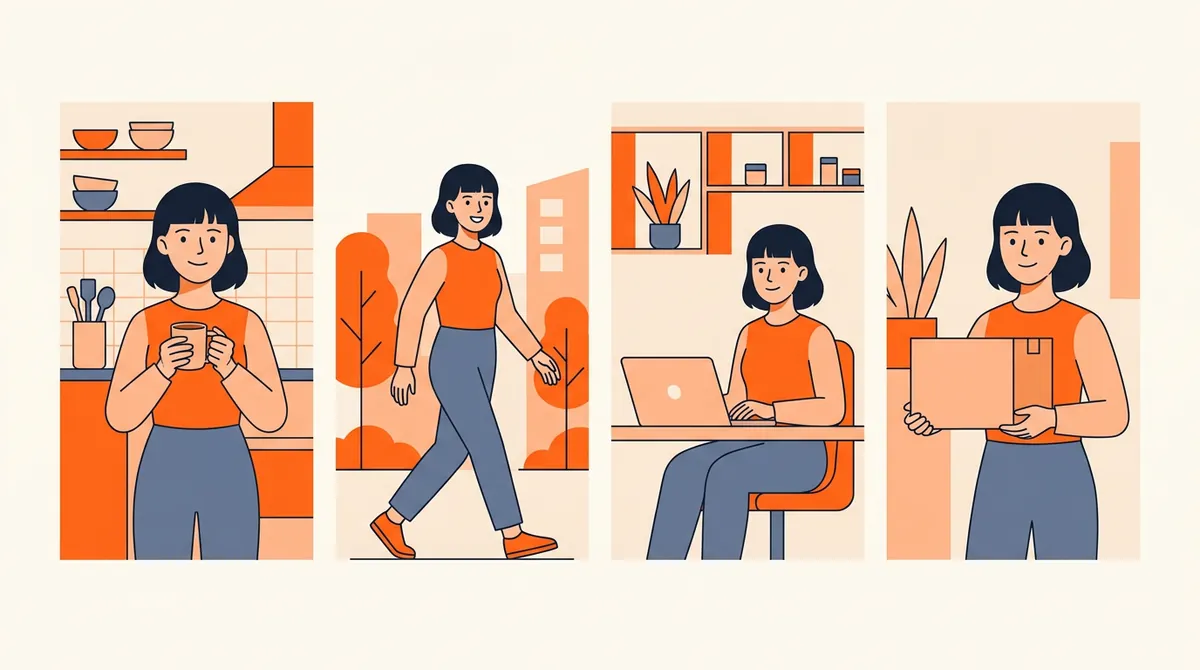
What should the persona look like?
Ordinary beats perfect. Hyper-polished faces with flawless skin read as fake on TikTok and Reels, where the native look is a phone held at arm's length in natural light. Pick a face your target viewer could plausibly meet, give the character a consistent wardrobe palette and a home setting, and avoid resembling any real person: a character that looks like a celebrity creates impersonation problems on every platform.
What should the character post?
The same things a good human creator in your niche would post: hooks that name a problem, quick wins, reactions, routines, opinions. If you want a deeper look at the formats themselves, our guide to UGC videos covers hooks, structures and what makes the style work. The AI part only changes who is on screen, not what makes a video worth watching. To turn the character into actual UGC-style videos, our AI UGC guide covers the workflow and what feels fake.
How do you keep an AI influencer consistent across videos?
Consistency is what turns a series of AI clips into a character people recognise. It is also where most attempts break: the nose changes, the age shifts by ten years, the hair goes from straight to curly between two posts. Viewers notice faster than you think.
| What drifts | Why it happens | How to prevent it |
|---|---|---|
| Face | Each generation reinvents the person from a text description | Always start from the same reference portrait, attached as an image, never from words alone |
| Age and build | Scene prompts pull the model toward a "typical" person for that setting | Restate age and build in the character sheet and keep it in every prompt |
| Style | Outfits and settings change randomly | A fixed wardrobe palette and two or three recurring locations |
| Identity mid-clip | Video models let the face morph over several seconds | Keep clips short, animate from a strong first frame, discard any take where the face shifts |
| Voice and tone | Scripts written by different people or prompts | One tone guide, a few signature phrases, the same synthetic voice if you use one |
Do you have to disclose that an influencer is AI-generated?
Yes, in most realistic cases, and the rules got stricter in 2026. A photorealistic person who does not exist is exactly the kind of content platforms and regulators want labelled. Treat disclosure as part of the format from day one rather than something to bolt on later.
| Where | What the rule says | What to do |
|---|---|---|
| TikTok | Creators must label realistic AI-generated content. TikTok also auto-labels content carrying C2PA Content Credentials (TikTok newsroom). | Turn on the "AI-generated content" setting when posting. |
| Instagram and Facebook | Meta requires people to use its disclosure tool for photorealistic video or realistic audio that was digitally created or altered, and may apply penalties if they do not (Meta newsroom). The result shows as "AI info". | Toggle the AI label in the advanced settings before sharing. |
| YouTube Shorts | Creators must disclose realistic altered or synthetic content, including a realistic scene that did not occur. Repeated failure can lead to penalties (YouTube Help). | Answer "yes" to the altered or synthetic content question at upload. |
| European Union | Article 50 of the AI Act applies from 2 August 2026: anyone deploying AI to generate image, audio or video "deep fakes" must disclose that the content is artificially generated, clearly, at the first exposure at the latest (Regulation (EU) 2024/1689). | A visible mention in the video or caption, on top of the platform label. |
| France | The law of 9 June 2023 on commercial influence requires content showing a face or silhouette produced by AI to carry the mention "Images virtuelles" (or, since a 2024 ordinance, an equivalent mention). Breaches can be punished by up to one year in prison and a €4,500 fine (Légifrance). | Show "Images virtuelles" on promotional content aimed at French audiences. |
Sponsorship rules still apply on top of all this. If the character promotes your own product, the account should make the commercial link obvious, exactly as a human creator would with "ad" or a paid partnership tag. And never present the character as a real customer: a fictional person giving a testimonial is a misleading claim, label or not.
What results can you realistically expect?
An AI influencer is a production method, not a growth hack. The feeds on TikTok, Reels and Shorts judge each video on whether people stop scrolling and watch, and a synthetic face does not change that. What it changes is your capacity: you can post every day, test a new hook every day, and never cancel because nobody felt like filming.
The limits to plan for
- The uncanny valley: hands, teeth and lip movement still give generated video away. Short clips, text-led formats and natural settings hide less, but they make the flaws matter less.
- Trust: some viewers will dislike the idea on principle, and comments will ask "is she real?". Answer honestly. Accounts that are open about their AI character tend to turn the question into engagement rather than a scandal.
- Weaker social proof: a character can explain, show and entertain, but it cannot vouch for your product. Pair it with real customer content when you have some.
- Sameness: the same face doing the same thing becomes wallpaper. Rotate angles and formats so the character has new things to say.
Running it as a system
The brands that get value from an AI character treat it like a recurring series, with a list of content angles, a fixed format mix and a daily or near-daily cadence. Our guide to automating short-form content with AI covers how to build that pipeline without it turning into generic slop.
This is the workflow Bloomr is built around. You create an AI influencer's face once, then animate that same person in as many UGC videos as you want, each in a new scene. The character can carry a wall of text written over the clip, which is often the most natural way to deliver a hook without a synthetic voice. Auto Gen drafts posts from your brand's content angles in the format mix you choose, you keep the ones you like, and you publish them directly or schedule them for TikTok, Instagram and YouTube Shorts. The AI label and the mentions above stay your call, but the face, the scenes and the posting rhythm stop being the bottleneck.