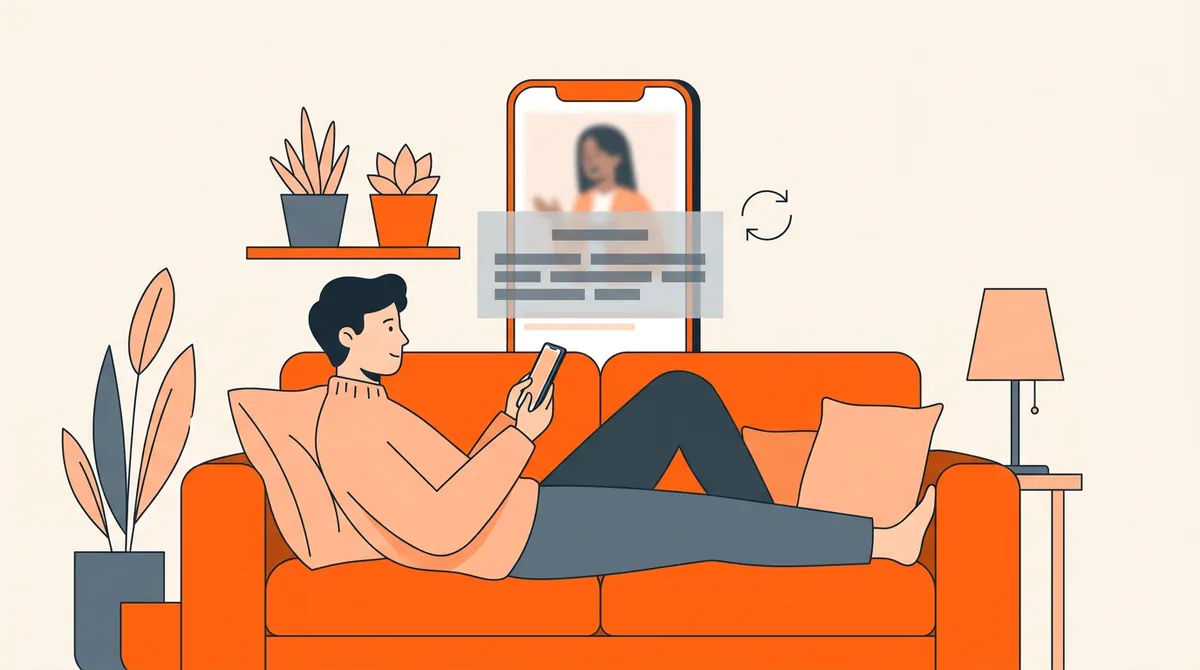
A wall of text video is a short-form video where a long block of text (often 40 to 150 words) sits on top of a short clip that loops: someone talking to the camera, a coffee being poured, a street at night. The viewer does not watch the video so much as read it. Because reading takes time, the video gets watched several times over, and that is exactly what TikTok and Instagram measure when they decide what to recommend.
The format is cheap to make, works without filming yourself and suits stories, opinions and lessons learned. This guide explains what a wall of text TikTok is, why it holds attention, how to write one that gets read to the last line, how to choose the background video, with examples by niche and the mistakes that make people scroll away.
What is a wall of text video?
The name says it: a "wall" of text, much longer than the one-line caption most videos put on screen. Where a classic text-on-video TikTok shows a hook for two seconds and then lets the footage talk, a wall of text keeps the whole message on screen. The video underneath is short (often 5 to 15 seconds), silent or covered by music, and plays on a loop until the viewer has finished reading.
You will also see it called a "text post video", "storytime with text" or a "long text TikTok". It is close to a carousel in spirit (the value is in the words), but it lives in the video feed and plays like a video.
Why do wall of text videos hold attention?
The mechanism is simple: reading time becomes watch time. A 7-second clip with 100 words on it cannot be read in 7 seconds, so a viewer who is interested lets it play two, three, four times. On a short video, that pushes the completion rate up and adds replays, two signals the platforms describe openly.
- TikTok: in its explanation of how the For You feed recommends videos, TikTok names finishing a longer video from beginning to end as a strong indicator of interest, and says the first likes, comments and replays trigger an early round of recommendations.
- Instagram: for Reels, Instagram says it predicts how likely you are to reshare a reel, watch it all the way through and like it, among other signals.
Two more effects make the format work beyond watch time. First, long text invites saves and shares: a list of lessons or a sharp opinion is something people want to keep or send to a friend ("this is literally you"). Second, text creates intimacy. A first-person story read in silence feels like a note from someone, not an ad, which is why the format suits founders and brands that want to sound human.
How do you write a wall of text people read to the end?
Most of the work is writing. The clip and the music take minutes to pick; the text decides whether the video lives or dies.
Start with a first line that works on its own
The first line is the hook. It is read in the first second, often before the viewer has decided to stay, so it must promise something specific. Good wall-of-text openers name a result, a mistake, a confession or a list: "3 things I wish I knew before launching my app", "Nobody tells you this about running a café", "I lost my first 50 customers because of one email". Put it at the top of the block, alone on its line, ideally in bold or a slightly larger size. For dozens of formulas, see our list of TikTok hook examples.
Pick a structure before you write
A wall of text without structure reads like a diary. Three structures cover most cases:
- The numbered list"3 things…", "5 mistakes…". Each point is one or two short lines. Easy to scan, easy to save, and the number tells the reader how long it will take.
- The mini storySituation, problem, turning point, lesson. "Two years ago I… Then… What changed everything was… Now I…". Ends on the lesson, not on a sales pitch.
- The takeA strong statement, two or three reasons, a closing line that sums it up. "You don't need more followers. You need the right 1,000." Works well for opinions that start debates in the comments.
Whatever the structure, the last line matters almost as much as the first. A closing line that lands (a punchline, a reversal, a question to answer in the comments) is what makes someone save or send the video once they have finished reading.
How long should the text be?
There is no official word limit for text on a video, but there is a practical one: the text has to fit on the screen at a readable size, inside the area the app does not cover. In practice, that means somewhere between a short paragraph and about 150 words. Past that, the font gets too small or the text runs under the buttons.
| Length | Roughly | Best for | Watch out for |
|---|---|---|---|
| Short | 25 to 50 words | A single take, a quote with commentary, a relatable thought | Can be read in one pass, so fewer replays |
| Medium | 50 to 100 words | Lists of 3 to 5 points, short lessons | The sweet spot for most niches |
| Long | 100 to 150 words | Stories, detailed advice, confessions | Needs a very strong first line and tight line breaks |
Cut every word that does not move the reader to the next line. Wall-of-text writing is closer to a tweet thread than to a blog post: short sentences, concrete words, no introduction.
Line breaks, legibility and safe zones
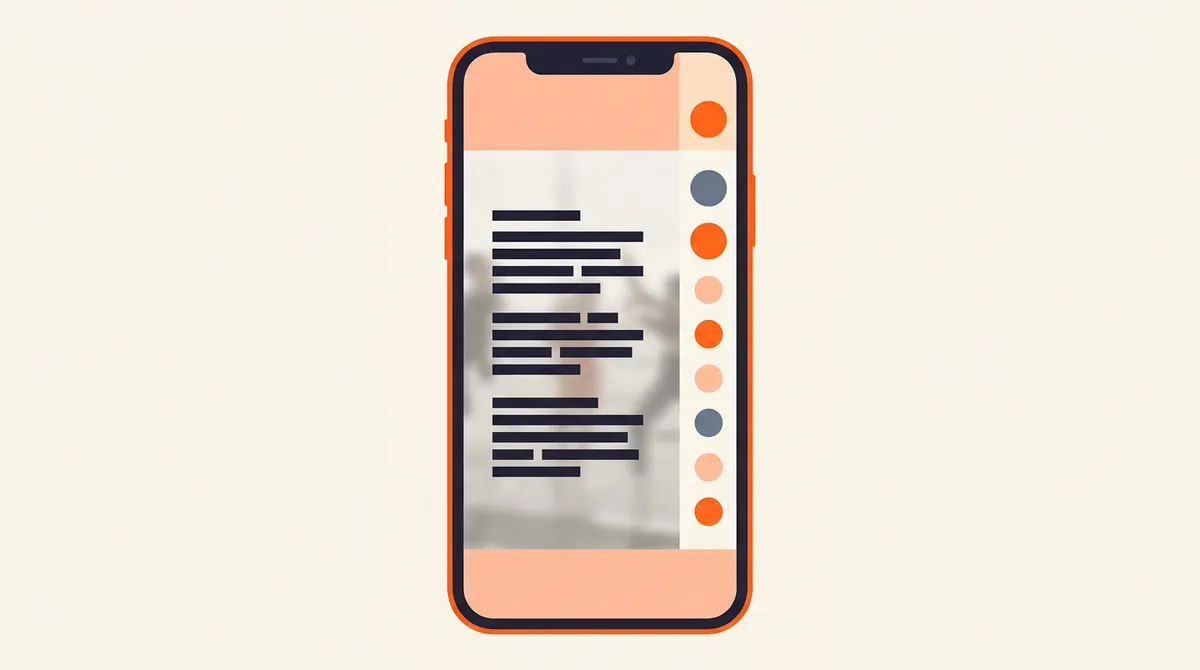
A wall of text should look like a wall from a distance and read like a list up close. A few layout rules make the difference between a block people read and a block they skip:
- Short lines and visible gaps: one idea per line, an empty line between groups. Dense paragraphs look like homework.
- Contrast first: white text with a dark outline or shadow, or dark text on a semi-transparent light box. The clip moves; the text must stay readable on every frame.
- One font, one size for the body: a clean sans-serif, with the hook slightly bigger or bolder. Highlight one or two key words at most.
- Stay in the safe zone: on TikTok and Reels, the top of the screen holds the tabs, the right side the like, comment and share buttons, and the bottom the account name and caption. Keep the text in the central area, slightly left of center, away from the right column and the bottom band. TikTok's own creative guidelines ask to keep content inside the UI safe zone; previewing the video in the app before posting is the quickest check.
Which background video should you use?
The background clip has two jobs: stop the scroll in the first frame and set the emotional tone, without stealing attention from the text. Two families dominate.
In both cases, choose a clip without strong movement in the middle of the frame (it fights the text), without its own captions, and short enough to loop smoothly. Your own footage is the safest choice. If you go faceless, stock clips or generated clips are fine as long as the text is original: platforms penalize reposting someone else's finished video, not using b-roll. Our guide on growing a faceless TikTok account covers those originality rules in detail.
Wall of text TikTok examples by niche
The format adapts to almost any niche where you have something to tell. A few first lines to adapt, with the background that fits them:
| Niche | First line | Background |
|---|---|---|
| App or SaaS founder | "3 things I wish I knew before launching my app" | Face to camera, tired at a desk |
| E-commerce brand | "We almost shut down in month 4. Here's what saved us" | Hands packing orders |
| Coach or consultant | "You don't need more motivation. You need fewer goals" | Face to camera, calm |
| Café or restaurant | "Things customers never see behind our counter" | Coffee being poured |
| Personal finance | "5 money rules I follow since I turned 30" | Notebook and calculator |
| Fitness | "I trained for 2 years without results. The mistake was this" | Gym ambience, slow motion |
| Freelance or agency | "The client email that changed how I price my work" | Face to camera, reading a phone |
Notice the pattern: each first line is specific (a number, a moment, a mistake) and promises a payoff the text will deliver. Each background echoes the emotion of the story rather than illustrating it literally.
- Lessons learned
- Confessions
- Lists of tips
- Hot takes
- Behind the scenes
- Customer stories
What are the most common wall of text mistakes?
Most failed walls of text fail for the same handful of reasons:
- A slow start: "So I've been thinking a lot lately…" Nobody reads past a warm-up. Start with the most interesting sentence.
- Too much text for the screen: if the font has to shrink to fit, cut the text instead. A smaller wall that is easy to read beats a long one that strains the eyes.
- Text under the buttons: the last lines hidden behind the caption or the share button are the ones that carry the payoff.
- A busy background: fast cuts, bright patterns or a clip with its own subtitles compete with the text.
- Generic quotes: motivational quotes copied from elsewhere are the opposite of original content and rarely get shared. Your own story, your own numbers, your own opinion.
- A sales pitch as the ending: end on the lesson or the punchline. If you sell something, mention it in the caption or let the bio do the work.
Making wall of text videos without the busywork
The format is simple, but posting several a week still means writing, finding a clip, laying out the text, picking a track and exporting for each platform. Bloomr handles that chain. It writes the long text from your brand's content angles and lays it over a face-to-camera UGC video picked from its catalogue to match the text, or over your own video. A length cap set per format (a maximum number of characters) keeps the text readable on screen, your brand's text style keeps every post recognizable, and a music track is added. You review the draft, edit what you want, then publish or schedule it to TikTok, Instagram and YouTube Shorts. See the wall of text video generator for how it works.
With or without a tool, the recipe stays the same: one first line worth stopping for, a structure the eye can follow, a clean layout in the safe zone and a background that sets the mood. Write ten, post them over two weeks, and keep the first lines and structures that got read to the end.