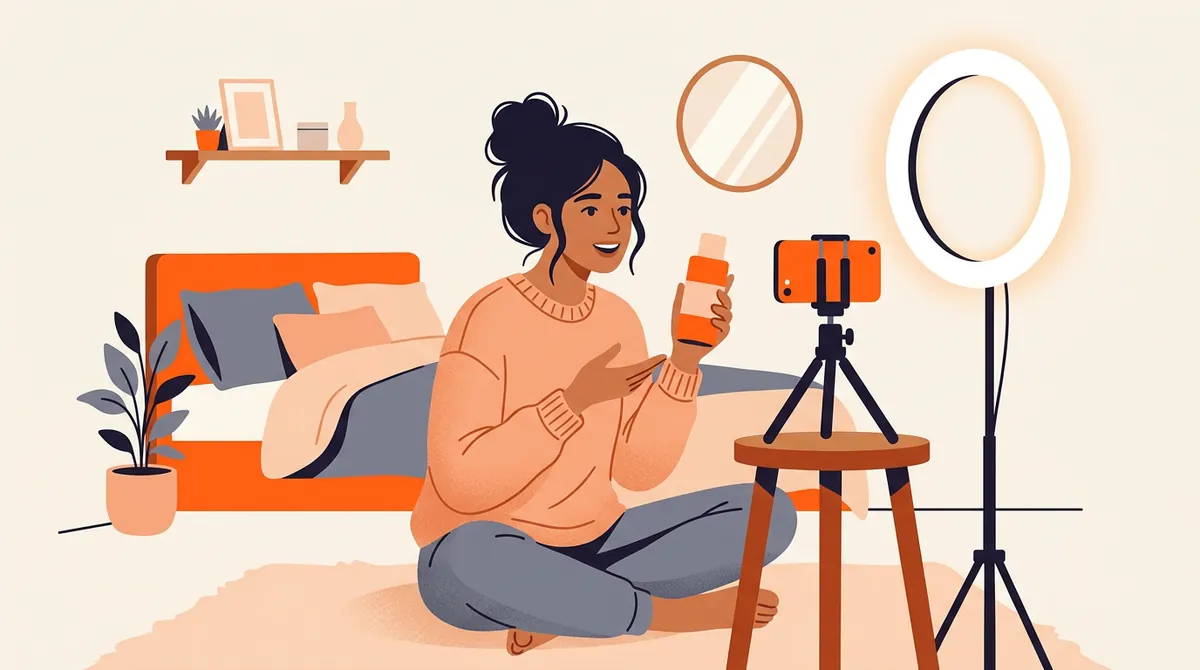
A UGC video is a short vertical video, usually filmed on a phone, in which a real person talks about a product or service the way a customer would: to the camera, in their own words, in their own room. UGC stands for user-generated content. The term started with content made by actual customers, but in marketing today it mostly describes a style: videos that look native to TikTok, Reels and Shorts rather than like an ad, whether they come from a customer, a paid creator or an AI-generated character.
Brands use UGC content because it borrows the most trusted form of persuasion there is: another person saying "this worked for me". This guide covers what counts as UGC, why it works, the formats worth making, where to get the videos and what they cost, how to script one, and the rights and disclosure rules that come with it.
What is UGC content, exactly?
"What is UGC" has two honest answers, and mixing them up causes most of the confusion around the term. The original meaning is content created by users with no brand involved: a review, an unboxing, a tagged post. The marketing meaning is content made to look and feel like that, usually commissioned. Today you can add a third source, AI-generated UGC. All three end up in the same feeds, but they come with very different costs, levels of control and obligations.
A useful distinction also exists between UGC creators and influencers. An influencer is paid largely for their audience: the post goes out on their account. A UGC creator is paid for the content itself: the video goes to the brand, which publishes it on its own accounts or runs it as an ad. Many creators do both, but the price and the contract are not the same.
Why do UGC videos work for brands?
The short answer is trust. People believe other people more than they believe brands. In Nielsen's Global Trust in Advertising survey, 83% of respondents said they trust recommendations from friends and family, and 66% trust consumer opinions posted online, well ahead of most paid formats. The 2021 edition of the same study put trust in recommendations from people you know at 88%. A UGC video is not a recommendation from a friend, but it borrows its codes: a face, a first-person story, a casual tone.
The second reason is the feed itself. On TikTok, Reels and Shorts, a polished ad is recognized and skipped in a fraction of a second. A person talking to their phone looks like everything else people chose to watch, so it gets the first two seconds that every video needs. That native look is why UGC works both as organic content and as ad creative.
The third reason is practical: UGC is fast and cheap to iterate compared with a production shoot. You can test five hooks on the same product in a week, keep the one that holds attention, and make more of it. For short-form, where volume and testing matter more than polish, that is a real advantage.
Which UGC video formats work best?
Most UGC videos fall into a handful of formats. Each one fits a different product and a different stage of the buyer's thinking. Pick two or three that suit your product and rotate them, rather than trying all of them at once.
| Format | What happens | Best for |
|---|---|---|
| Testimonial | A person tells their experience with the product, face to camera. | Services, apps, anything where the result is the selling point |
| Unboxing | First opening of the package, first reactions, first use. | Physical products with nice packaging or a surprise inside |
| Routine / GRWM | "Get ready with me" or "my morning routine", with the product used naturally along the way. | Beauty, fashion, food, wellness, productivity tools |
| Problem-solution | A frustration everyone recognizes, then the product that fixes it. | Almost everything: the most reliable format to start with |
| Before / after | The visible state before, the state after, the product in between. | Cleaning, skincare, home, design, any visual result |
| Reaction | The creator reacts to the product, a claim or a comment, often with green screen. | Products people doubt, bold claims, answering objections |
| "3 reasons" | A numbered list: three reasons I switched, three things I wish I knew. | Comparisons with competitors, considered purchases |
Two other variants deserve a mention. The "wall of text" video puts a long, punchy text over a face-to-camera clip: the person barely speaks, the story is on screen. And the "hook + demo" video opens with a reaction or a bold line, then cuts to the product in use, which suits apps and SaaS where the screen is the proof.
How do you get UGC videos?
From your customers
Real customer videos are the most credible and the hardest to get. A few things increase the supply: a card in the package asking for a video, a follow-up email after a few weeks of use, a small reward (a discount, early access) in exchange for an honest review, a branded hashtag you actually repost from. Always ask for written permission before reusing a customer's video, and be aware that a reward counts as a material connection for disclosure purposes.
From UGC creators
UGC creators are people, often with small or no audiences, who film videos for brands on demand. You find them on marketplaces (Collabstr, Billo, Insense and similar), through TikTok's own creator tools, or by contacting people whose style you like. Collabstr's 2026 influencer marketing report, built on more than 21,000 collaborations, puts the average UGC asking price at $180 and the average price actually paid at $154 per deal. Vendor guides commonly quote $100 to $300 for a beginner and several hundred dollars for experienced creators, before extras.
What moves the price: the number of hooks or variations, raw footage, the length, a professional edit, and above all usage rights. Paid ad usage and longer licenses add to the base rate, often substantially. Agree on all of it in writing before the shoot.
With AI
AI UGC uses a generated character in place of a filmed creator. The best results today come from keeping one consistent face across many videos, so the account feels like it has a recurring host rather than a new stranger each time. It solves the volume problem (you can test ten hooks in an afternoon) and the availability problem, at the cost of some authenticity. We cover how to build one in our guide on how to create an AI influencer. For the production side (prompts, hook + demo, AI labels), see our guide to making AI UGC videos.
| Source | Cost per video | Control | Volume | Credibility |
|---|---|---|---|---|
| Customers | Free or a small reward | Low | Low, unpredictable | Highest |
| UGC creators | Around $150 to $300+ | High, via the brief | Limited by budget | High |
| AI UGC | Low | Full | High | Depends on execution and labeling |
Most brands end up mixing the three: customer videos as proof, creator videos for the ads that need a real face, and AI or in-house videos to keep a daily organic cadence.
How do you brief and script a UGC video?
A good brief is short and specific. It gives the creator the product, the audience, the one thing the video must make people feel or understand, the format, the length (15 to 45 seconds covers most cases), what not to say (medical claims, competitor names), the deliverables and the deadline. Then it leaves the words to the creator: a script read word for word sounds like an ad, which defeats the point.
Whatever the format, almost every UGC video that works follows the same five beats.
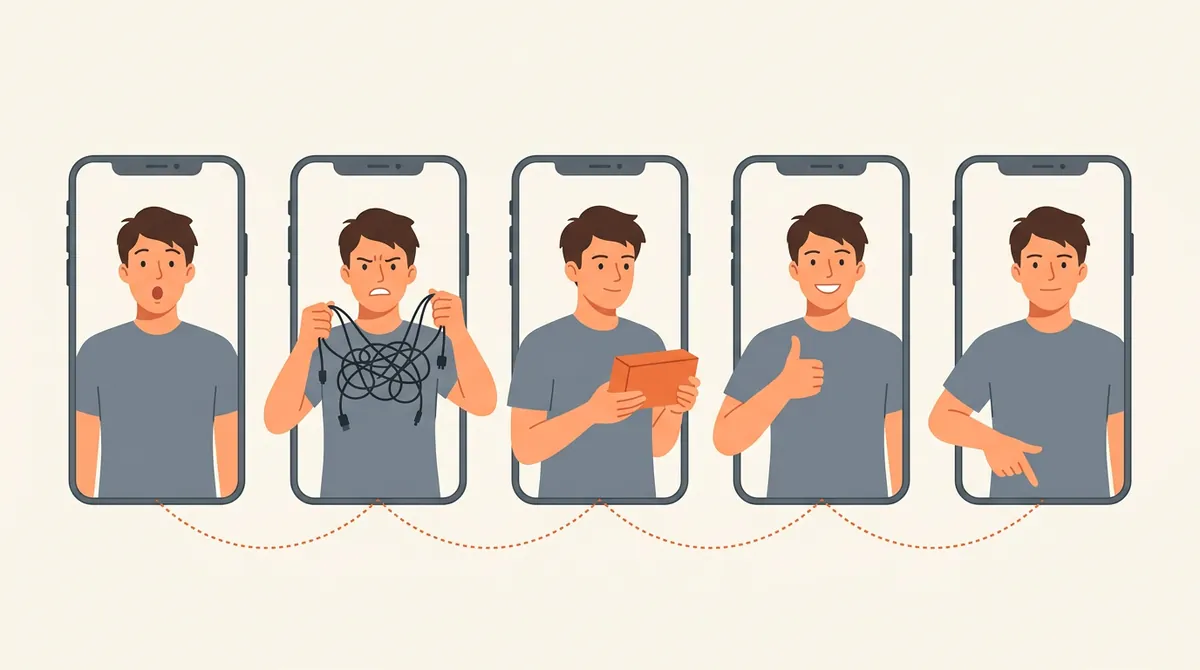
- Hook (0 to 3 seconds)One line, on screen and spoken, that makes the right viewer stop. "I wasted $400 before finding this" beats "Hi guys, today I want to show you".
- ProblemThe frustration in the viewer's words, specific enough that they recognize themselves.
- ProductThe product appears as the answer, in use, in the person's hands or on their screen. Show, do not list features.
- ProofA result, a before/after, a number, a detail only a real user would notice. This is where credibility is won or lost.
- Call to actionOne simple next step: "link in bio", "try it free", "save this for later". For organic posts, a soft CTA or none at all often works better.
On the technical side: vertical 9:16, natural light, clean audio (a cheap clip-on mic helps more than a better camera), on-screen captions because many people watch without sound, and key text kept away from the edges where each app places its buttons.
What about usage rights and disclosure?
Usage rights
Paying for a video does not automatically mean you can use it everywhere, forever. The contract should say where the video can be used (your organic accounts, paid ads, website, email), for how long, whether you can edit it or cut new versions, and whether you get the raw footage. For customer videos, a simple written permission (a reply to a DM or an email saying yes) is the minimum.
Disclosure
When a creator who received money, a free product or any other benefit talks about your product, the relationship must be disclosed. In the US, the FTC's Disclosures 101 for Social Media Influencers asks for clear words such as "ad" or "sponsored", placed where they are hard to miss, and, for video, inside the video itself rather than only in the caption. Vague tags like "collab" or "sp" are not enough, and a platform's paid partnership label may not be enough on its own. The FTC also expects the brands that pay creators to make sure they disclose.
When the video is posted on your own brand account, it is already clear who is speaking, but a creator or AI character presenting the product as a neutral customer can still mislead. Do not invent testimonials, do not have an actor claim results they never had, and do not hide that a character is generated when the law or the platform requires a label.
Should you use UGC for organic content or for ads?
Both, but they reward slightly different things. As ad creative, UGC is judged on conversion: a strong hook, a clear offer, a direct CTA, and enough variations for the ad platform to find a winner. As organic content on your own accounts, UGC is judged on watch time and shares: the video has to be worth watching even for someone who will not buy today, so story and entertainment matter more and the sales pitch matters less.
- Organic first: post UGC-style videos on your accounts, see which hooks and formats hold attention, and keep the winners.
- Ads second: put money behind the videos that already proved themselves organically, with the usage rights to do so.
- Volume throughout: one great UGC video is not a strategy. What builds results is a steady flow, which is why the cost per video matters so much.
That last point is where most small brands get stuck: a few creator videos a month do not add up to a daily presence. One option is to automate part of your short-form content with AI and keep paid creators for the moments that need a real face. Bloomr was built for that cadence: it makes UGC-style videos for your brand, including wall-of-text videos over a face-to-camera UGC clip and hook + demo videos for products, and its AI influencers let you create a face once, then animate the same person in as many UGC videos as you want. Auto Gen drafts posts from your brand's content angles, you keep the good ones, and you schedule or publish them directly to TikTok, Instagram and YouTube Shorts.